
Most agencies will never show you what happens to their work after the engagement ends. The reason is straightforward: most of the time, nothing happens. The rankings sit where they were left. The traffic holds briefly, then slides. The visibility that was rented month to month returns to where it started.
This case study documents the opposite. It is the data from a real engagement with a home services business where the system kept producing after the last invoice was sent. Not slightly. Meaningfully. The rankings that were building in month four continued building into month five and beyond, without a single new piece of content published or a single additional dollar spent.
This is what a correctly built SEO system looks like when the work is done right. And it is also what the data looks like when a business owner disconnects from results at exactly the wrong moment.
The Engagement
The client operated a regional home services business. The engagement ran from June 2025 through early December 2025. The work included keyword-targeted content published to the site, on-page optimization, local keyword expansion across the business’s service area, and synchronized paid social campaigns structured to drive behavioral signals to the published content.
The last content was published in early December 2025. The December invoice went unpaid. The engagement ended.
What the data showed in January 2026 was not a plateau. It was continued acceleration.
What the Traffic Data Shows
The two periods being compared are June through September 2025, the first four months of the engagement, and October 2025 through January 2026, the four months that followed including the month after work stopped.
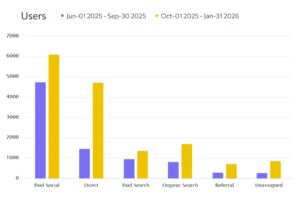
Every single traffic channel grew from the first period to the second. Paid social users increased from approximately 4,700 to 6,050, a direct result of the synchronized campaigns running against the published content. Paid search grew modestly from 950 to 1,350.
The two numbers that matter most for understanding what the SEO system actually produced are organic search and direct traffic.
Organic search grew from approximately 775 users to 1,650 users. More than doubled. These are people who found the business by typing something into Google and clicking a result without any ad in front of them. That number does not double because of ad spend. It doubles because Google is ranking the content and sending traffic to it.
Direct traffic grew from approximately 1,450 users to 4,650 users. More than tripled. Direct traffic is people who already know the business name and seek it out intentionally. You cannot buy direct traffic. You earn it by being visible and trusted enough that people remember you. A direct traffic number tripling means the market was building real brand recognition across those eight months.
Both of these numbers, the organic search and the direct traffic, grew without any new content being published after early December. The system that was built in the first six months was still compounding in January.
What the Ranking Data Shows
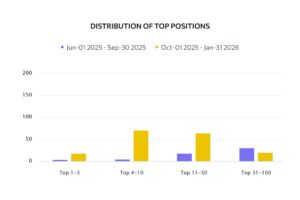
The position distribution chart shows where keywords were ranking at the start versus where they were ranking by the end of the second period.
In the first four months, the keyword distribution was flat. Almost nothing ranked in the top 3. A handful of terms sat in the top 4 through 10. A moderate number sat in the top 11 through 30. The bulk of tracked terms were in the 31 through 100 range.
By the end of the second period, the picture was fundamentally different. Top 1 through 3 positions grew from near zero to approximately 16 keywords. Top 4 through 10 grew from roughly 4 keywords to 70. Top 11 through 30 grew from about 16 to 63.
The top 31 through 100 range actually shrank. Those keywords did not disappear. They graduated. They moved up into higher position brackets.
The most important detail: the last content was published in early December. These January numbers reflect a system that had been running without any new inputs for over a month. The rankings kept climbing on their own because the behavioral signals, the real user engagement that had been driven to the content through the synchronized paid campaigns, had already told Google what it needed to know. The authority was built. The rankings were the result.
What This Data Actually Means for Business Owners
The difference between an SEO system that compounds and a marketing spend that disappears is not about the dollar amount. It is about what the money builds.
Ad spend that stops producing the moment the campaign ends built nothing. Every dollar went toward rented visibility. The moment the campaign stopped, the visibility went with it.
A correctly built content system does something different. Each piece of content that earns a ranking continues earning that ranking after publication. Each behavioral signal that gets driven to that content through a synchronized ad campaign accelerates the organic authority of the page. The organic authority does not expire when the campaign ends. It accumulates. The rankings that were at position 40 in month three may be at position 12 in month six without any additional work, because the foundation that was built in month three is still being evaluated and rewarded by Google in month six.
That is the compounding effect. It is not a marketing claim. It is documented in the data above.
Why This Client’s Story Matters
The owner of this business made a decision to stop paying for the engagement at the point when the data was showing the strongest growth of the entire campaign period. The January numbers were stronger than December. The February numbers, had the relationship continued, would likely have been stronger than January.
That decision was made not because the results were poor, but because the business owner was not connected to the data in a way that made the growth visible to him. He was not watching organic search climb. He was not tracking direct traffic month over month. He did not have a clear picture of what the ranking distribution looked like at the start versus what it looked like at the end.
This is not an indictment of the business owner. It is an indictment of an industry that has trained business owners to distrust marketing data because the data they have been shown for years has not connected to anything real.
The lesson is not that you should blindly trust your SEO provider. The lesson is that organic search growth and direct traffic growth are the numbers that tell you whether something real is being built. When those numbers are climbing month over month and the ranking distribution is shifting upward, the system is working. Disconnecting from it at that moment is not a cost saving. It is a decision to abandon compounding returns at the point of acceleration.
What This Engagement Demonstrates About AI Search
The content built during this engagement was not designed for a specific moment in time. It was built to answer specific search queries, structured so the primary answer appeared in the first section of the page, and internally linked to reinforce topical authority across the site. That structure is the same structure that Google AI Overviews and large language models use when deciding what content to cite.
AI tools do not separate their citation sources from their organic ranking sources. Per research published in early 2026, sites that rank well in organic Google results are also the sites that get cited in AI-generated answers. The content built for this engagement was building toward that citation authority in January 2026, which is the same period when AI search was beginning to influence how business owners find service providers.
The compounding effect applies to AI visibility as well as organic rankings. A page that builds authority over time does not lose that authority when the engagement ends. It continues to be a candidate for AI citation as long as the content remains accurate, relevant, and structurally sound.
Ready to Build a System That Compounds?
Every Nico SEO engagement is built on the same foundation documented in this case study: keyword-targeted content, synchronized paid social campaigns that drive real behavioral signals, and monthly tracking that makes the growth visible before it becomes obvious.
The difference between a system that compounds and a spend that disappears is the foundation. Use the contact form to start the conversation about your business specifically.
You can also read why most small business SEO fails before it starts for a deeper breakdown of what the foundation looks like when it is missing, or explore the handcrafted SEO system that produced these results.
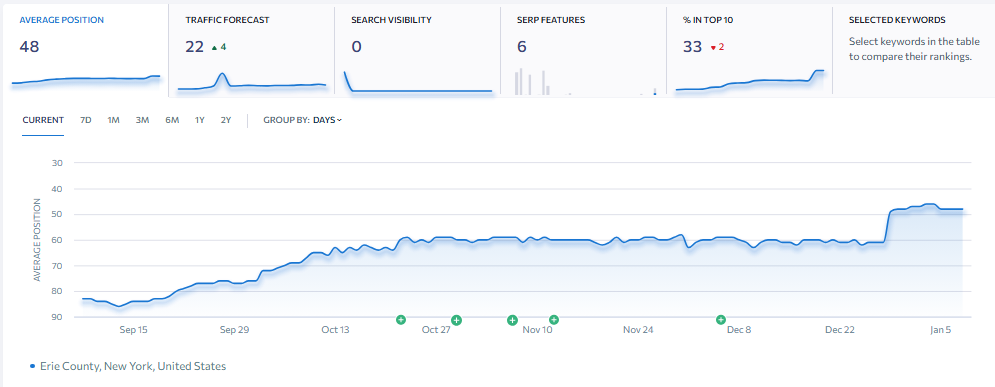
A 4-month local SEO campaign in Erie County, NY that moved average keyword position from 76 to 48 and grew top-10 rankings from 1% to 35%.
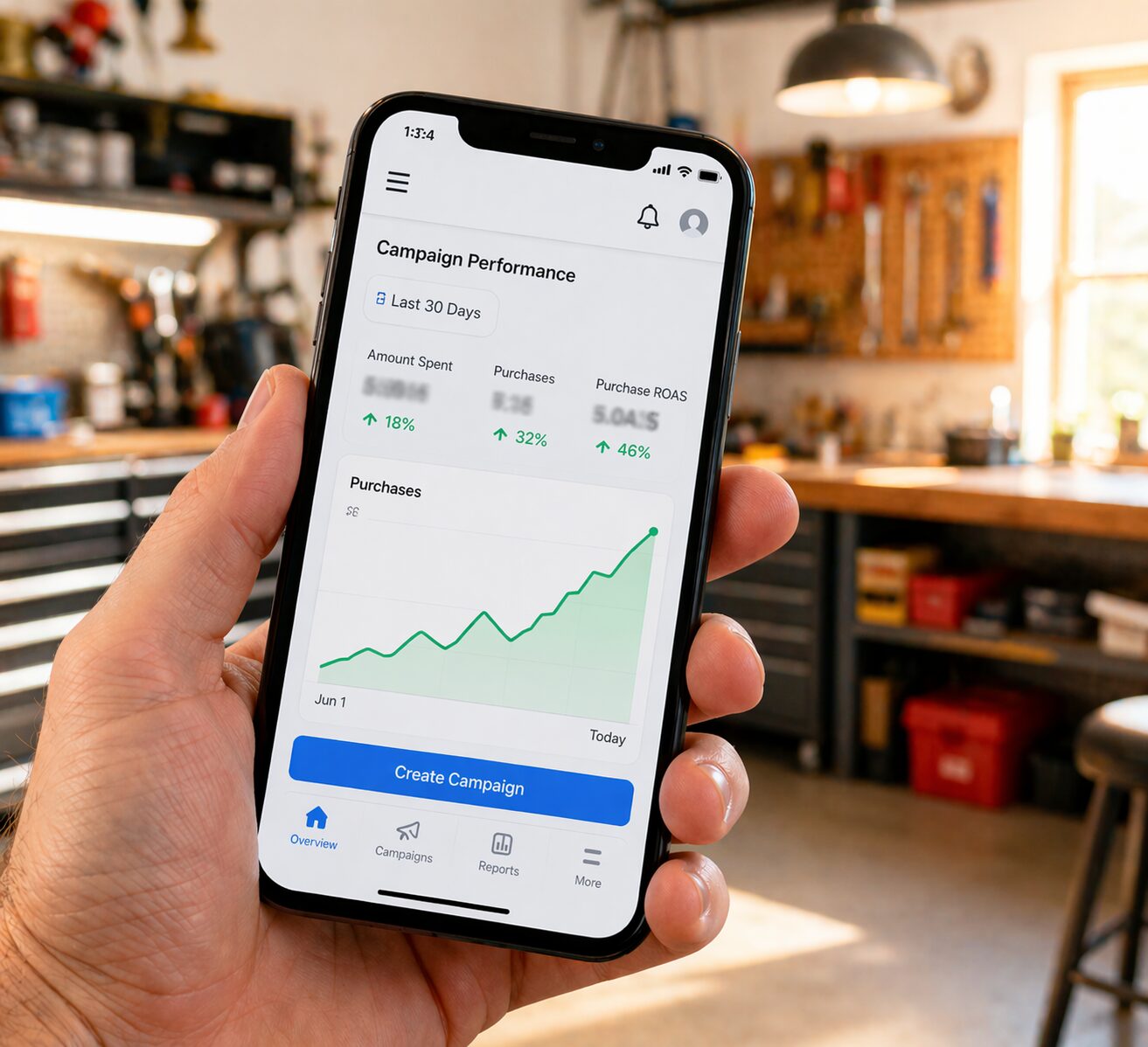

Able Tent Rental went from 10 monthly inquiries to 31 in 90 days, earned the #1 spot in Google’s AI Overview for WNY tent rental services, and reached 60,000 unique Erie County residents through Meta advertising. Here is exactly how the campaign was built and what drove the results.