

Most small businesses that say SEO did not work for them never actually had SEO working for them in the first place.
They had content. Some of them had a lot of it. They had a Google Business Profile. Some ran Meta ads and Google ads at the same time. They received monthly reports from agencies showing metrics that looked like progress but never translated into revenue. And at some point, usually after spending far more than they intended, they concluded that SEO is either a scam, a long game that does not apply to their business, or a thing that works for bigger companies but not for them.
Most small business SEO fails before the first article is ever published. Not because the content is bad, not because the market is too competitive, and not because SEO does not work for small businesses. It fails because the foundation that makes SEO compound was never built.
Three things must exist before SEO can do anything useful for a small business. Without all three, no content strategy, no ad campaign, and no agency retainer will produce results that last. If you have been through this before and want to understand what the foundation actually looks like, start with a conversation here.
The Foundation That Makes Everything Else Work
The three foundational pieces are a properly installed tracking pixel, connected analytics tied to actual business outcomes, and keyword-targeted content built around what buyers actually search, not what an agency thinks they should rank for. Every real result in small business SEO traces back to whether these three things exist and whether they are working correctly together.
First: The Tracking Pixel
A Facebook Pixel is not optional for any small business running Meta ads alongside an SEO strategy. It is the mechanism that tells you whether the ad spend connects to actual site behavior. Without it, every campaign metric, every cost per click, and every reach number exists in isolation from what actually happens when someone lands on your site.
This situation is more common than it should be. A national ecommerce brand came to Nico SEO in early 2026 after spending approximately $3,000 per month on Meta and Google advertising and working with multiple SEO agencies over nearly a decade. Total spend across those years ran well into six figures. When the audit happened, no Facebook Pixel had ever been installed on either of their two active websites.
Not misconfigured. Not outdated. Not tracking the wrong events. Never installed.
Every dollar spent on Meta advertising across the life of that business went out without any ability to connect ad activity to site behavior. There was no way to know which ads drove purchases, which drove traffic that bounced immediately, or whether the ad spend produced anything measurable at all.
The Pixel was installed in March 2026. Within hours, PageView and ViewContent events were firing and confirmed live in the platform. For the first time in the history of the business, the owner could see exactly what his advertising was producing on the site.
That is what the foundation looks like when it is missing, and what it looks like when it is built correctly.

Second: Analytics Connected to Outcomes
Google Analytics is the other half of the measurement foundation. For an ecommerce business, it needs to connect to the actual store platform, not just sit as a code snippet on a homepage. For a service business, it needs to track form submissions, phone call clicks, and other conversion events, not just pageviews and session counts.
The same business had Google Analytics access set up but had never connected the GA4 property to their Shopify store. Google could see traffic arriving, but could not attribute any of it to sales, cart additions, or downstream purchase behavior.The traffic data existed. The sales data existed. They were disconnected from each other.
What Connected Analytics Actually Changes
When analytics connects correctly, you stop managing a marketing budget by instinct and start managing it by data. You know which articles drive conversions and which pull in traffic that does not convert. You know which ad audiences produce revenue and which generate engagement that looks good in a report but does not produce customers.
Most small businesses either do not have analytics installed at all, have it installed but disconnected from their platform, or have it connected but not tracking the right conversion events. All three situations produce the same result: a business owner writing checks for marketing they cannot evaluate.

Third: Keyword-Targeted Content Built From a Weight Audit
This is where the majority of small business SEO money gets wasted, and it is the most invisible waste because content looks productive even when it is not.
Publishing blog posts is not SEO. Publishing blog posts written around the specific search terms your buyers actually use, weighted by conversion intent, and structured to answer the primary query in the opening section of the page is SEO. The difference in outcome between those two approaches is not marginal. One earns rankings. The other fills a word count.
The right process starts before anyone writes a word. A keyword weight audit maps every trackable search term in your market. It assigns each term an intent classification and weights it by conversion potential. Weight 3 terms are the ones your buyers search when they are ready to buy, call, or contact. Weight 2 terms cover research and comparison searches that happen earlier in the decision process. Weight 1 terms are contextual, supporting topical authority without driving direct inquiries on their own.
How the Weight Audit Drives Article Structure
Every article in a correctly built content system targets a primary Weight 3 cluster and uses Weight 2 and Weight 1 terms to support it. The article gets structured so the most important answer to the most important search appears in the first 20 to 30% of the page. That placement matters because both search engines and AI tools prioritize content in that opening section when deciding whether a page is worth citing or ranking. You can see the full process behind how this system gets built on the Nico SEO Proven Process page.
For the ecommerce brand referenced in this article, no keyword-targeted content had ever existed on either of their two active websites before Nico SEO began. Blog posts were short product announcements written without buyer intent research behind them. Two keyword-targeted articles went live in late March 2026. Within two weeks, Google began testing the site at positions 1 and 3 for terms that had no ranking presence before those articles published.
That movement did not happen because the articles were long or because they contained certain words a certain number of times. It happened because Nico SEO built each article to answer a specific high-intent search query, structured it correctly, linked it internally to the right product pages, and immediately supported it with ad campaigns that drove real buyer-profile traffic from the right geographic markets to those specific pages.

What Happens When All Three Exist and Work Together
Cost per landing page view in the first campaign cycle: $0.08 to $0.09. The benchmark for Meta ecommerce campaigns typically runs $0.50 to $0.70 or higher. The platform flagged the campaign as outperforming 80% of similar ads in its category.
Post engagement on a single piece of content: 1,100 plus reactions. The brand’s prior record across its entire Facebook history was 23.
Sessions week over week in the first campaign week: up from 6,755 to 7,549.
Sales in the first full campaign week: up 209%.
Why the Results Compound Instead of Stop
These numbers did not come from a better ad strategy in isolation. They came from building the foundation that the previous agencies had skipped. The Pixel connected the ad spend to site behavior. Analytics connected site behavior to business outcomes. Keyword-targeted content gave the ad campaigns something worth sending traffic to. And the ad campaigns gave the new content the behavioral signal it needed to accelerate the organic ranking process.
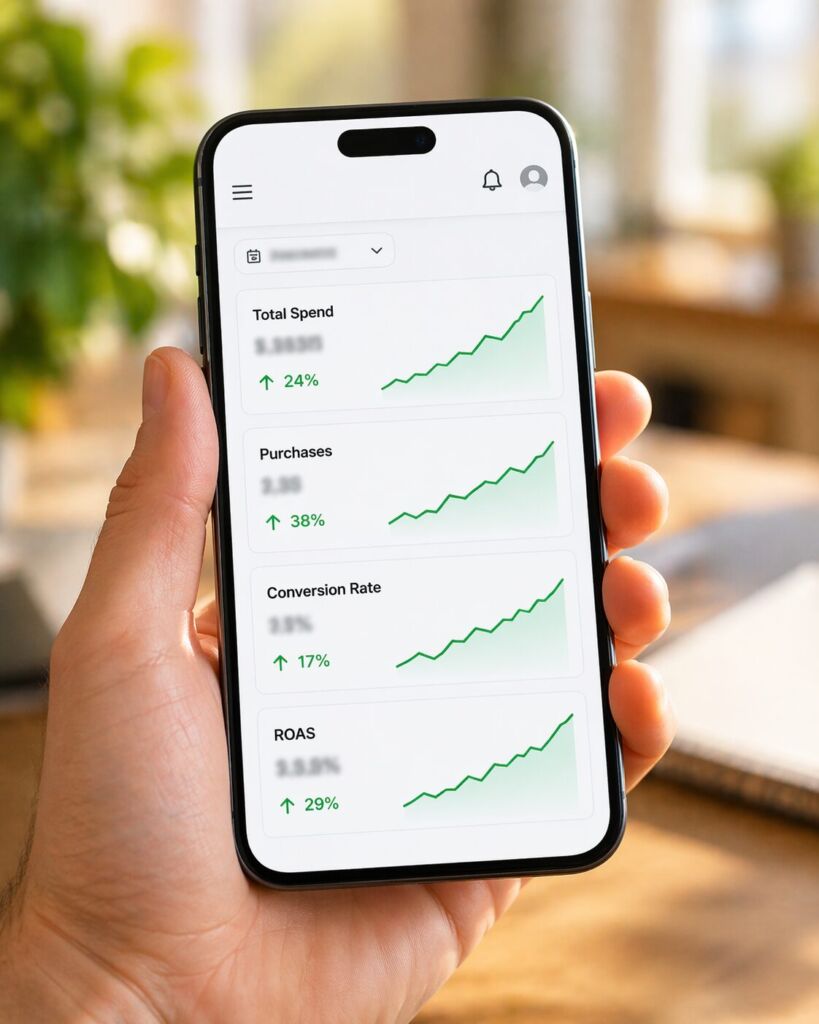
All three working together is the system. Any one of them missing is why most small business SEO fails before it starts. You can see how that full system gets built from the ground up on the handcrafted SEO and Meta advertising system page.
Ready to see what the full case study produced? Follow Nico SEO on LinkedIn for updates as the complete data publishes, or connect on Facebook to stay in the loop.
Is Your Foundation Built Correctly?
If you have spent money on SEO or paid advertising and have not seen the results that were promised, the first question is not what content to publish next or which ad creative to test. The first question is whether the three foundational pieces exist and whether they connect correctly.
That question is where every engagement with Nico SEO begins. A direct conversation about your business, your current tracking setup, your content, and your ad history before any proposal is made or any retainer is signed. Reach out directly at contact@nicoseo.com or use the contact form to start that conversation.
Frequently Asked Questions
Why does a Facebook Pixel matter if I am focused on SEO and not paid advertising?
The Pixel is not only for paid advertising performance tracking. When ad campaigns run alongside keyword-targeted content, the Pixel allows those campaigns to track which specific pages drive engagement and which audiences convert. That data feeds back into audience optimization and retargeting. For small businesses using both organic content and paid social, the Pixel is part of the foundational infrastructure that connects the two systems.
How do I know if my Google Analytics is actually tracking what matters?
The test is simple: can you open your analytics dashboard and see which specific pages, traffic sources, or campaigns produced contact form submissions or purchases in the last 30 days? If the answer is no, your analytics is not tracking what matters. It may show traffic data, but traffic data without conversion attribution is not actionable.
How long does keyword-targeted content take to produce ranking results?
First movement for new content typically appears in weeks three through six after publication, assuming the content is well-structured and supported by some initial behavioral signal. Meaningful position movement into the top 20 for target terms is a months two through four outcome. Compounding results where rankings continue strengthening without additional content investment typically become visible at month six and beyond.
What is a keyword weight audit and why does it come before content?
A keyword weight audit maps every trackable search term in your market and assigns each one a conversion weight based on buyer intent, search volume, and competitive opportunity. It is what tells you which terms to build content around and which terms are noise. Publishing content without this audit is the core reason most small business SEO produces generic rankings on terms that do not drive revenue.
Can Nico SEO work with businesses that have already spent money on SEO with other agencies?
Yes, and most of the businesses in the Nico SEO portfolio came with a previous agency history. The audit process identifies what exists, what is missing, and what is working before any new content or ad spend begins. Reach out here to start the conversation about your specific situation.
