

The Phrase “search engine optimization” tells you almost nothing useful.
SEO is traffic and sales you do not have to pay for.
When someone searches “HVAC company near me” or “truck bed rack with tonneau cover” and clicks on your website without you running an ad, that is SEO working. You did not pay for that click. You did not pay for that visitor. Google decided your page was the best answer to that search and sent someone to you for free. That is what SEO produces when it is built correctly, and it keeps producing after the work is done.
That is the whole thing. Everything else is just explaining how to get there.
What Is Organic Search and Why Does It Matter?
Inside your website analytics, traffic gets sorted into categories based on how people found you. Two of those categories tell the most important story about whether your SEO is working.
Organic search is people who found you by typing something into Google and clicking your result. They were not sent there by an ad. Google showed them your page because it determined your content was relevant and trustworthy enough to rank for that search.
Direct traffic is people who came to your site by typing your URL directly or clicking a saved bookmark. These are people who already know your name. They came back on their own.
Those two numbers, organic search and direct traffic, are the ones that tell you whether your business is building real momentum online. When they grow month over month, your business is earning visibility and trust that compounds over time. When they are flat or declining, it usually means the only traffic coming in is paid, and paid traffic stops the moment you stop paying.
Growing your organic and direct numbers is the goal. Everything Nico SEO does is built around moving those two numbers upward every single month.
What SEO Is Not
This is where most businesses get burned, and it is worth being direct about it.
Google Ads is not SEO. Running Google Ads means paying Google to place your website at the top of search results for specific terms. The moment you stop paying, you disappear. There is nothing wrong with Google Ads as a tool, but it is paid advertising, not search engine optimization. Any agency that sells you Google Ads management and calls it SEO is not being straight with you.
Social media management is not SEO. Posting on Facebook or Instagram builds brand awareness and engagement. It does not directly improve your Google rankings or grow your organic search traffic. Again, nothing wrong with social media as a tool. It is just not SEO.
Listing management is not SEO. Making sure your business shows up correctly on Google Maps, Yelp, and local directories matters for local search, but it is one small piece of a much larger system. Agencies that charge a monthly retainer for citation management and call it an SEO campaign are collecting a fee for minimal work.
The reason most agencies sell these things as SEO is straightforward. They are easier to deliver and easier to bill for than real SEO. And they keep you dependent on them. The moment you stop paying, the ads stop, the posts stop, and your visibility goes away.
Real SEO is different. Real SEO is content built around what your buyers actually search, published to your website, structured so that Google understands exactly what your page is about and who it should show it to. When that content earns a ranking, it keeps ranking. When your organic search numbers grow, they do not reset to zero when the invoice stops.
How Real SEO Actually Works
Real SEO starts with research. Before anyone writes a single word, the right keywords need to be identified. Not just any keywords, but the specific search terms your buyers use when they are ready to buy, call, or contact you. Those terms get mapped by conversion potential and search intent, which determines what content gets built and how it gets structured.
Then the content gets written. Each article targets a specific cluster of high-intent search terms. It is structured so the most important information appears at the top of the page, because that is where Google and AI search tools look first when deciding whether to rank or cite a page. The content gets linked internally to the right pages on your site so Google can follow the path between related topics.
After the content is published, something important happens. Real buyers need to actually engage with it. This is where the paid social layer comes in, and this is what separates the Nico SEO system from a content-only approach.
This process works the same way whether the business is a local HVAC company serving Erie County or a national ecommerce brand shipping to all 50 states. The keyword research changes. The geographic targeting changes. The content angle changes. The foundation does not. Every engagement starts with the same audit, the same weight classification, and the same structure before a word gets written. That consistency is what produces repeatable results across different industries and different markets.
Why Paid Social Is Part of the SEO System
Google does not just look at what your page says. It also looks at how real people interact with your page. When someone from your target market clicks through to a piece of content, reads it, and spends time on it, Google registers that as a signal that the page is relevant and valuable for that search. The more of those signals a page accumulates, the stronger its rankings become.
The problem with brand new content is that it has no signal history. It has not ranked yet, so no one has found it through search. No one has clicked on it from Google results because it is not on the first page yet.
Paid social solves this by sending real people from your actual target market directly to that content. A Facebook ad targeting the right geographic area and the right audience profile drives real local buyers to the page. Google observes real engagement. The page builds authority faster than organic-only content would. Rankings improve on an accelerated timeline.
This is why the system compounds. Every month of content adds more pages building authority. Every ad campaign drives more behavioral signals to those pages. Every new ranking brings more organic traffic. The organic and direct numbers grow month over month without requiring ongoing ad spend to sustain them.
That is the difference between renting visibility and building it.
Why Most Agencies Will Not Tell You This
The agency model depends on recurring monthly fees tied to services that require ongoing payment to function. Google Ads management requires you to keep running ads. Social media management requires you to keep posting. The moment you stop paying, the results stop.
Real SEO does not work that way, which makes it harder to sell as a dependency model. An agency that builds your organic rankings correctly is building something you keep even if you eventually stop working with them. That is a harder business model for most agencies to sustain, so most agencies do not offer it.
The ones that do charge for the content, the strategy, and the system. Not for the ongoing dependency.
What Growing Organic and Direct Numbers Looks Like in Practice
A national ecommerce brand came to Nico SEO in March 2026 after spending approximately $3,000 per month on advertising with multiple agencies over nearly a decade. No keyword-targeted content existed on their site. No tracking was in place to connect ad spend to site behavior.
Within two weeks of publishing two keyword-targeted articles and launching synchronized ad campaigns, Google began testing the site at positions 1 and 3 for search terms that had no ranking presence before. Organic and direct traffic began building independently of the ad spend.
A Buffalo-area HVAC and home services company started with an average keyword position of 76 and 1% of tracked keywords ranking in the top 10. Four months later, average position reached 48 and top-10 coverage grew to 35%. Contact form entries increased by 250%. Rankings continued improving after the campaign ended.
The data below shows exactly what that growth looks like across every traffic channel. The purple bars represent the first four months of the engagement. The yellow bars represent the following four months. Every channel grew. Direct traffic more than tripled.
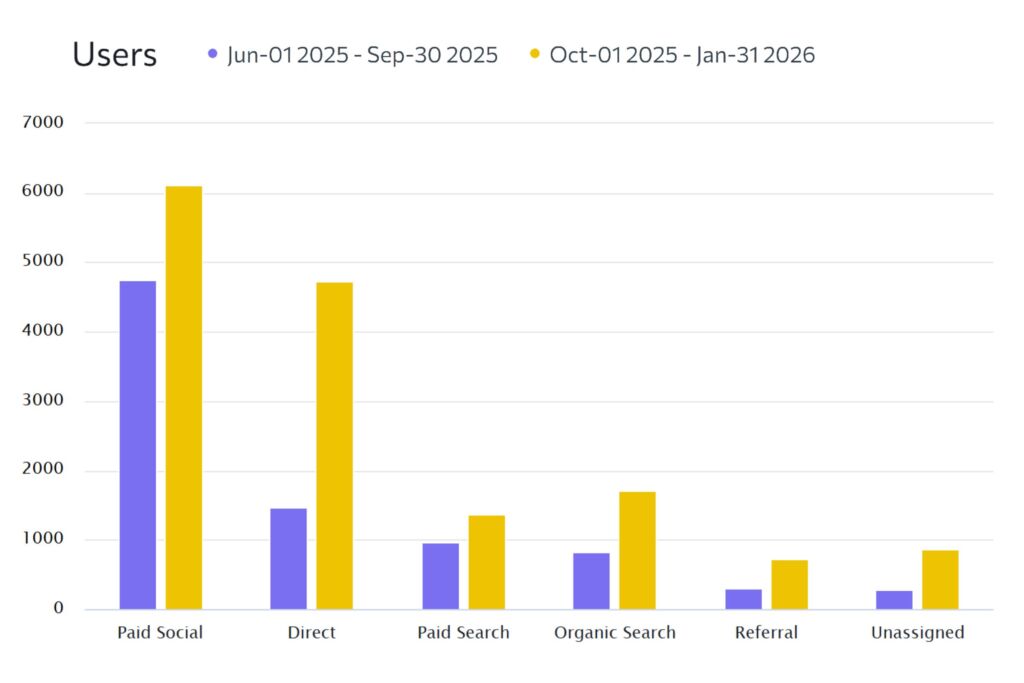
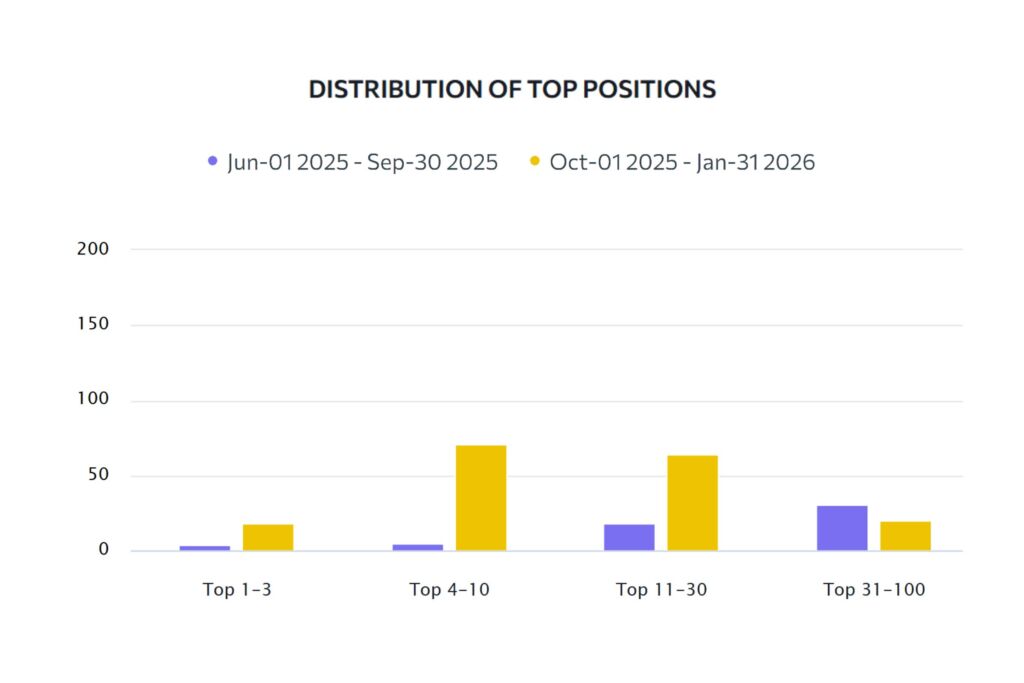
The keywords in the 31-100 range actually decreased. They did not disappear. They graduated into higher positions. That is the compounding effect in practice.
The keyword ranking distribution tells the same story from a different angle. At the start of the engagement, almost no keywords ranked in the top 10. By the end of the second period, 70 keywords had moved into the top 4 through 10 positions and 63 more sat in the top 11 through 30, one more month away from page one.
Those organic and direct numbers growing month over month is what SEO looks like when it is working. Not an ad report. Not a reach metric. Real people finding your business through search without you paying for each one of them.
Is Your Business Building Real SEO or Paying for Visibility That Disappears?
If you are spending money on digital marketing and your organic search and direct traffic numbers are not growing month over month, the answer is probably that you are paying for visibility rather than building it.
The first step is understanding what you actually have. What does your organic traffic look like right now? What are your rankings for the searches your buyers actually use? Is there keyword-targeted content on your site or just product pages and a blog that has not been updated in two years?
Those questions are where every Nico SEO engagement starts. A direct conversation about what exists, what is missing, and what it would take to start building the numbers that compound. Use the contact form to start that conversation, or reach out directly at contact@nicoseo.com.
You can also see how the full system gets built on the Nico SEO handcrafted SEO and Meta advertising system page, or read why most small business SEO fails before it starts for the deeper breakdown of what the foundation looks like when it is missing.
Frequently Asked Questions
Is SEO better than Google Ads?
They serve different purposes. Google Ads produces immediate visibility but stops the moment you stop paying. SEO builds organic rankings that persist and strengthen over time. The Nico SEO approach uses paid social advertising alongside organic content to accelerate the ranking process, but the goal is always to grow the organic and direct traffic numbers that do not require ongoing ad spend to sustain.
How long does it take for SEO to produce results?
First keyword movements typically appear in weeks three through six after publishing new content. Meaningful top-20 rankings develop between months two and four. The compounding effect where rankings continue strengthening without additional content investment becomes visible at month six and beyond.
Why is my organic traffic not growing even though I have been paying for SEO?
The most common reason is that what you purchased was not organic SEO. If the agency was managing Google Ads, social media, or citations, those services do not directly grow organic search traffic. Real organic SEO requires keyword-targeted content published to your website. If that content does not exist, organic traffic will not grow regardless of how much you spend on other services.
What is the difference between organic search and direct traffic?
Organic search is people who found your site through a Google search without clicking an ad. Direct traffic is people who came to your site by typing your URL or clicking a bookmark. Both numbers growing month over month indicate that your business is building real visibility and brand recognition online rather than depending entirely on paid advertising.
Does social media help SEO?
Social media does not directly improve Google rankings. However, paid social advertising used to drive real target-market traffic to keyword-targeted content creates behavioral signals that accelerate the organic ranking process. That is the specific mechanism the Nico SEO system uses, and it is distinct from general social media management.
