
What Happens When You Stop SEO? A 14-Month Local SEO Case Study
When the SEO work on this site stopped in late 2025, its rankings kept improving into January, then gave back most of their top 10 positions over the following ten months. The top 30 held up far better. Here is the full record, from the first tracked day in September 2025 through November 1, 2026.
The client and the work
This is the Buffalo-area home services company from my first case study on this client. I started on the site in August 2025 and worked on it for about four months. The work was local service content for Erie County suburbs including Amherst, Williamsville, Cheektowaga, Clarence, and Tonawanda, plus on-page optimization and technical SEO fixes.
Rank tracking began in September, a month into the engagement, so the baseline here is September 10, 2025, the lowest point in the tracked data. I tracked 272 keywords, all service plus location searches, in Google USA for Erie County, New York. Every number on this page comes from a dated rank tracker snapshot.
The numbers
Three dates tell the story: the September 10, 2025 baseline, the January 15, 2026 peak, and November 1, 2026. “Share of gain kept” is how much of the improvement between the baseline and the peak was still in place in November.
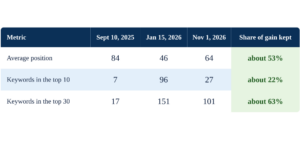
Every figure on this page comes from a dated snapshot. My first case study on this client uses a September 2 starting point and early January numbers. This page uses fixed dates throughout, so each figure traces to a single snapshot.
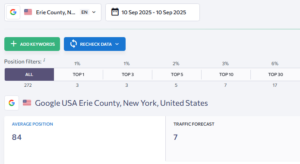
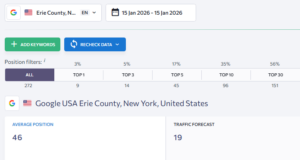
At the baseline, 7 of the 272 tracked keywords (3 percent) ranked in the top 10. At the peak, 96 did (35 percent). On November 1, 27 did (10 percent). Here are the tracker’s own snapshots for those three dates.
September 10th 2025:
January 15th 2026:
November 1st 2026:
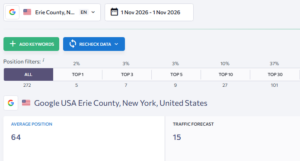
How the 14 months played out
While the work was being done: September to November 2025
From the September 10 baseline of 84, average position improved steadily through the work period and reached about 60 by November. The content built for the Erie County suburbs was getting crawled, indexed, and moving up. Google Search Console shows the traffic side of the same period. The site’s strongest click days came while the work was active, with daily clicks reaching 75 at the high point.
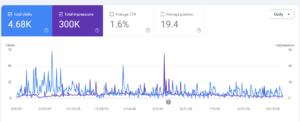
After the work stopped: November 2025 to January 2026
The work stopped in late 2025, and the rankings did not stop with it. Content takes weeks to be crawled, evaluated, and moved up, so the effort from the work period was still maturing. Average position climbed from about 60 to 46. The January 15 snapshot shows 96 keywords in the top 10 and 151 in the top 30, with no new work going into the site.
The first fade: February to April 2026
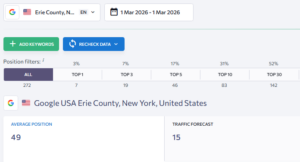
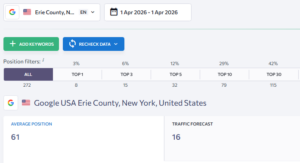
Rankings stayed near the peak through February. March 1 showed 83 keywords in the top 10 and 142 in the top 30. Then the first real loss arrived. By April 1, average position had slipped to 61 and the top 30 had dropped to 115, while the top 10 held at 79.
The plateau: April to November 2026
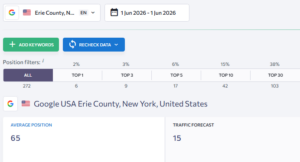
April to June was the second leg down, with the top 10 falling from 79 keywords to 42 by June 1. After that the site flattened out. From June 1 to November 1, average position moved from 65 to 64 and the top 30 count from 103 to 101. The top 10 gave up another 15 keywords over that stretch and ended at 27. The site held that level for five months.
Here are the three snapshots between the peak and November.
March 1st 2026:
April 1st 2026:
June 1st 2026:
What held and what faded
The top 30 is where the lasting value sits. About a year after the work ended, the site still had 101 keywords in the top 30, up from 17 at the baseline. That is nearly six times the starting count, and 63 percent of the peak gain stayed in place. Average position is 64 against a starting 84, so even after the fade the site ranks 20 positions better than before the work began.
The top 10 is where the losses concentrated. That count fell 72 percent from the January 15 peak, from 96 keywords to 27. It is still nearly four times the 7 keywords the site had at the baseline. The 11 to 30 band grew from 55 keywords in January to 74 in November, so some of the top 10 losses were slides of a few positions rather than full drops. Net, the top 30 lost 50 keywords over the same stretch.
What this shows about SEO
SEO fades slowly. Ad results stop the day the budget stops. Organic rankings kept most of their top 30 footprint for a year with no new work, and the positions closest to page one were the first to slip. Page one is where search clicks concentrate, so that is the range that needs ongoing content and upkeep to hold.
Rankings are a moving target. Competitors keep publishing, Google keeps updating, and pages age. A site that stops adding to its content system slides, and the data above is what that looks like. It is why I run SEO as a monthly content system instead of a one-time project. When rankings do move on one of my sites, I trace the cause the way I did in this ranking drop diagnosis.
The work period builds the asset, and ongoing work protects it. A site on a monthly content system keeps adding pages and strengthening existing ones, so a peak like January 15 becomes a starting point instead of a high-water mark. If you want the fundamentals behind why this happens, start with What Is SEO?
Frequently asked questions
Does SEO stop working when you stop doing it?
Not right away. On this site, rankings kept improving for about two months after the work stopped. A year later the site still had 101 keywords in the top 30, up from 17. The strongest positions faded the most: the top 10 went from 96 keywords to 27.
How long do SEO results last after you stop?
It depends on the market, the competition, and how deep the site’s content is. On this site, the top 10 lost 54 of its 69 lost keywords in the first five months after the January 15 peak. Then the site leveled off and held steady from June through November.
What keeps SEO results from fading?
Ongoing content that targets the same service and location searches, regular updates to existing pages, and rank tracking so slips get diagnosed early. That is what my monthly content system does.
Want results that hold?
If you want to see where your own site stands, contact me, call 716-680-0653, or email Contact@nicoseo.com. You can see more of my work on the Results page.